
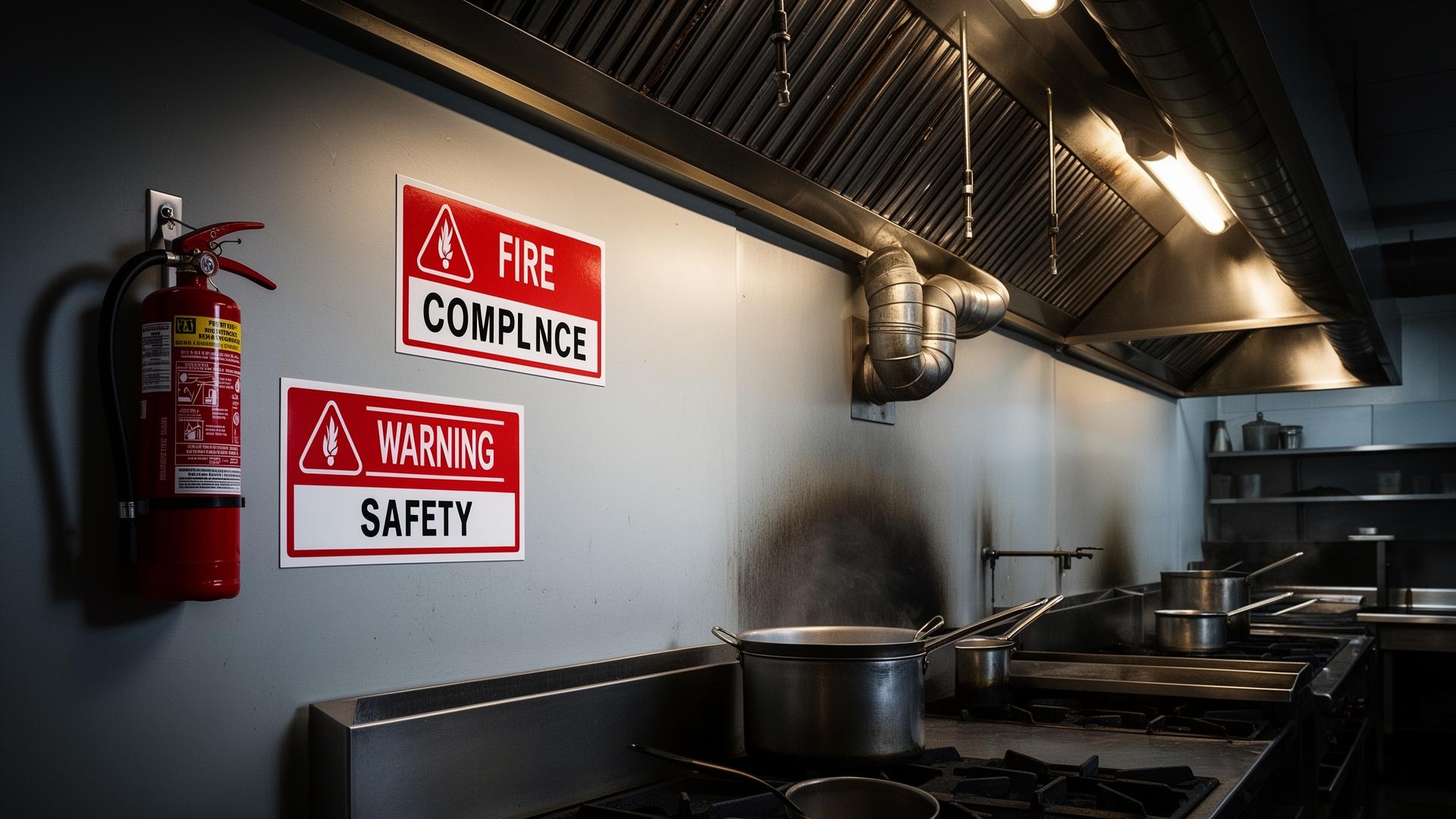
Fire in a commercial kitchen is not a theoretical risk. It is a statistical certainty for any premises that operates long enough without proper maintenance. The Fire & Rescue Service responds to thousands of commercial kitchen fires every year in the UK, and a significant proportion of those fires originate in or spread through the kitchen extract system — the network of canopies, filters, ductwork, and fans that remove heat, steam, and grease-laden air from the cooking area. When grease accumulates inside this system, it becomes fuel. A single spark, a flare from a pan, or an overheated bearing in a fan motor can ignite those deposits. Once a fire takes hold inside a duct, it can spread rapidly through the building, bypassing fire compartmentation, reaching concealed voids, and creating conditions that are extremely difficult for fire crews to control.
This is not a maintenance issue. It is a life safety issue. And in the eyes of the law, responsibility falls squarely on one person: the responsible person under the Regulatory Reform (Fire Safety) Order 2005.
Who Is the Responsible Person?
The Regulatory Reform (Fire Safety) Order 2005 — commonly known as the RRO or the Fire Safety Order — is the primary piece of fire safety legislation in England and Wales. It replaced a patchwork of older regulations and certificates with a single, risk-based approach. Under the RRO, the "responsible person" for any non-domestic premises is typically the employer, or the person who has control of the premises. In practice, this means the building owner, the tenant, the facilities manager, or any combination of these, depending on the lease arrangements and the specific circumstances.
The responsible person has a legal duty to carry out a fire risk assessment, to implement and maintain appropriate fire precautions, and to ensure that those precautions remain effective. This duty is ongoing — it is not something you do once and file away. And critically, the duty extends to all aspects of the premises that affect fire safety, including the kitchen extract system.
When a fire risk assessor examines a commercial kitchen, one of the first things they will look at is the extract system. They will ask to see evidence that the system has been cleaned in accordance with TR19, by a competent contractor, at the frequency appropriate to the type of kitchen. If that evidence does not exist, the fire risk assessment is deficient, and the responsible person is potentially in breach of the RRO.
What TR19 Requires — and Why It Matters Legally
TR19 is published by the Building Engineering Services Association (BESA) and is recognised as the industry standard for the cleaning of ventilation systems. It is not a piece of legislation in itself — there is no "TR19 Act" — but it is referenced extensively by fire safety professionals, insurers, and enforcement bodies as the benchmark for competent cleaning of kitchen extract systems.
Under TR19, kitchen extract systems must be cleaned at intervals determined by the type of cooking and the volume of use. A heavy-use fast food kitchen frying continuously may need cleaning every three months. A light-use facility such as a café that primarily serves cold food and reheats pre-prepared meals may be adequate with an annual clean. The specification provides guidance on determining the appropriate frequency, but the responsibility for implementing that programme lies with the responsible person.
Crucially, TR19 also specifies the standard of cleaning that must be achieved. It is not enough to wipe down the canopy and change the filters. The entire system — canopy interior, ductwork, fan, and discharge — must be cleaned to a measurable standard. Post-clean verification is carried out using grease deposit thickness (DFT) readings taken with a calibrated gauge. The readings must demonstrate that residual grease deposits are within acceptable limits. These readings, along with before-and-after photographs, form part of the post-clean verification report, which is the documentary evidence that the work has been done to the required standard.
This documentation is what connects TR19 to the legal framework. When a fire officer, an insurance loss adjuster, or a coroner asks whether the kitchen extract system was properly maintained, the answer is in the TR19 post-clean verification report. If the report exists, is credible, and shows compliant readings, the responsible person can demonstrate that they took reasonable steps to manage the fire risk. If the report does not exist, or if it is from a contractor who cannot demonstrate competence, the responsible person has a problem.
The Insurance Dimension
Insurance companies have become increasingly sophisticated in their understanding of kitchen extract fire risk. Many commercial property and business interruption policies now contain specific conditions relating to kitchen extract maintenance. Some policies explicitly require TR19-compliant cleaning at specified intervals. Others use broader language about maintaining fire safety precautions, but the effect is the same — if a fire occurs and the insurer discovers that the extract system had not been properly maintained, they may reduce or refuse the claim.
This is not hypothetical. There are documented cases where insurers have successfully voided claims on the basis that the policyholder failed to maintain the kitchen extract system. The financial consequences can be devastating. A kitchen fire that might otherwise be covered by insurance — including the cost of repairs, business interruption, and third-party claims — becomes an uninsured loss that the business must bear entirely.
For contractors, this creates an opportunity and a responsibility. When you clean a kitchen extract system and issue a TR19 post-clean verification report, you are not just providing a service — you are providing the evidence that the client needs to satisfy their insurance obligations. The quality and credibility of your documentation matters enormously. A hastily completed report with no photographs, no DFT readings, and no clear identification of the areas cleaned is of limited value. A thorough, professional report with calibrated readings, geotagged photographs, and clear identification of every system component is worth its weight in gold to a client facing an insurance claim.
Enforcement and Prosecution
Fire safety enforcement in England and Wales is carried out by the local fire and rescue authority. Under the RRO, fire safety inspectors have the power to enter premises, inspect fire safety arrangements, and take enforcement action where they find deficiencies. Enforcement can range from informal advice and recommendations, through formal enforcement notices (which require specific improvements within a set timeframe), to prohibition notices (which can close a premises or restrict its use immediately if there is a serious risk to life), and ultimately to prosecution.
Prosecution under the RRO can result in unlimited fines and, in the most serious cases, imprisonment. The penalties were increased significantly by the Fire Safety Act 2021, which also clarified the scope of the RRO in relation to multi-occupied residential buildings following the Grenfell Tower tragedy. While the Grenfell-related changes are primarily focused on residential buildings, the increased penalties apply to all premises covered by the RRO, including commercial kitchens.
In practice, most enforcement action related to kitchen extract systems takes the form of enforcement notices requiring the responsible person to implement a proper cleaning and maintenance programme. Prosecution is reserved for the most serious cases — typically where there has been a fire, where the system was in a dangerously neglected state, or where the responsible person has failed to comply with a previous enforcement notice. But the trend is clear: fire safety enforcement is becoming more rigorous, and kitchen extract systems are receiving more attention than ever.
The Grenfell Effect on Kitchen Extract Compliance
The Grenfell Tower fire in June 2017, and the subsequent public inquiry, fundamentally changed the approach to fire safety in the UK. While Grenfell was a residential building and the fire spread through external cladding rather than a kitchen extract system, the inquiry exposed systemic failures in fire safety management, regulatory enforcement, and the competence of those responsible for building safety. The resulting legislative changes — including the Fire Safety Act 2021 and the Building Safety Act 2022 — have created a much more demanding regulatory environment across all building types.
For commercial kitchen operators, the most significant impact has been a heightened awareness of fire risk among building owners, managing agents, and insurers. More clients are now asking for TR19 certificates proactively, rather than waiting for a fire risk assessment to identify the gap. More insurers are including specific TR19 requirements in policy conditions. More fire risk assessors are checking extract system documentation as a matter of course.
This is a positive development for competent contractors, because it creates demand for high-quality, compliant cleaning services. But it also raises the stakes. In a post-Grenfell world, the consequences of poor fire safety management are taken more seriously by everyone — regulators, insurers, juries, and the public. A contractor who cuts corners on cleaning, who issues certificates without doing the work properly, or who fails to identify and report serious deficiencies in an extract system is not just risking their reputation. They are potentially contributing to conditions that could result in a fire, and the legal and moral consequences of that are severe.
Practical Steps for Building Owners
If you are a building owner or facilities manager responsible for premises with commercial kitchens, here is what you need to do. First, identify every kitchen extract system in your portfolio. This sounds obvious, but in large or complex estates, extract systems can be overlooked, especially in properties that have been extended or refurbished over time. Second, commission a TR19 survey of each system by a competent contractor. The survey will assess the condition of the system, identify any access or maintenance issues, and recommend a cleaning frequency. Third, implement a cleaning programme at the recommended frequency, using a contractor who cleans to TR19 standards and provides proper post-clean verification reports with DFT readings. Fourth, retain all documentation — survey reports, post-clean verification reports, and maintenance records — in an organised, accessible file. This is the evidence you will need if your fire risk assessment is inspected, if an insurance claim arises, or if a fire safety officer asks to see your records. Fifth, review the programme annually, or whenever the kitchen use changes, to ensure that the cleaning frequency remains appropriate.
These steps are not optional extras. They are the minimum required to discharge your legal duty under the Regulatory Reform (Fire Safety) Order and to maintain the fire safety of your premises. The cost of a proper TR19 cleaning programme is modest compared to the potential cost of a fire, an uninsured loss, or a prosecution. And the peace of mind that comes from knowing your premises are properly maintained is, frankly, invaluable.