
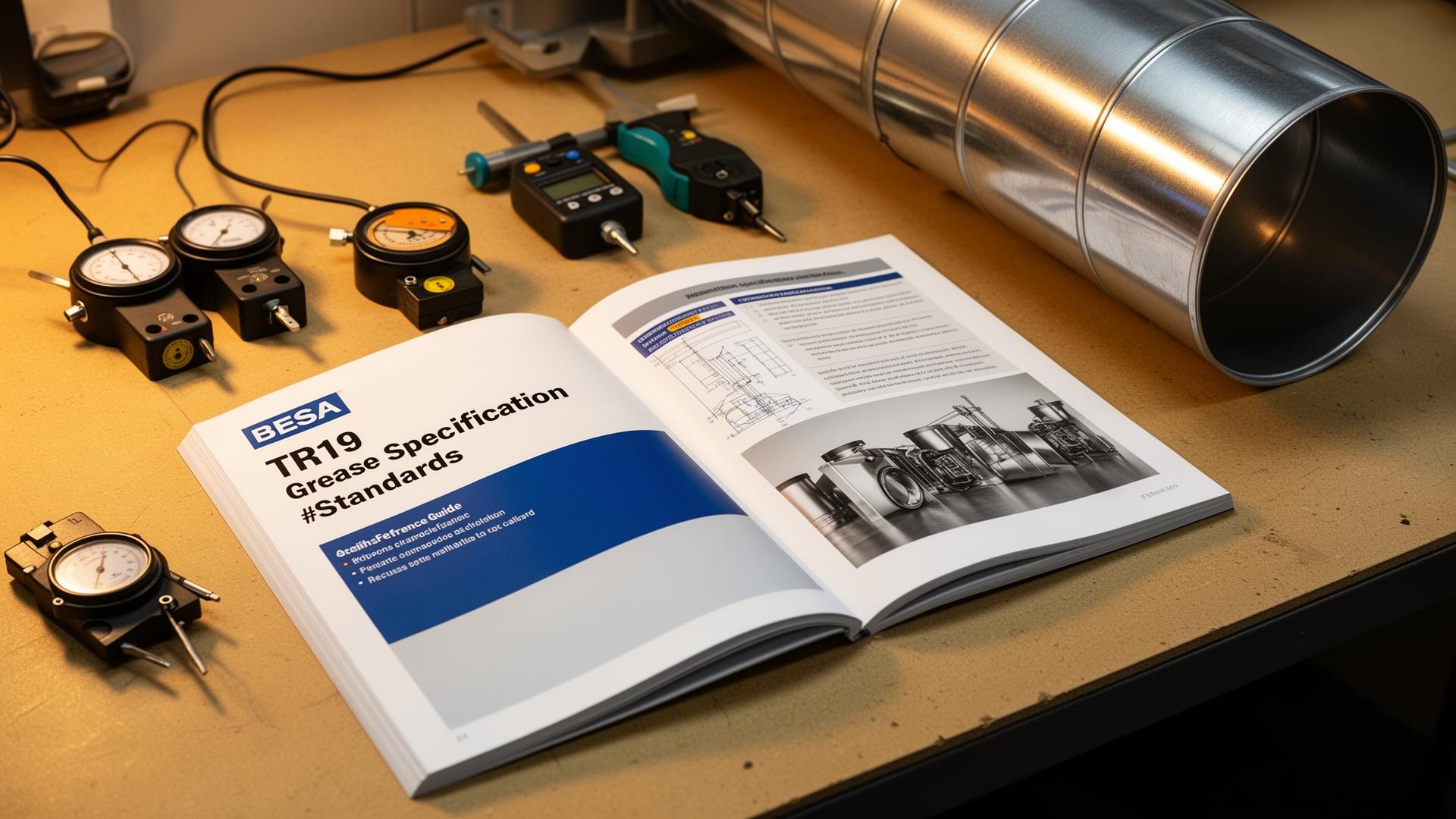
The BESA TR19 Grease Specification is the defining standard for kitchen extract cleaning in the United Kingdom. It sets out the requirements for assessing, cleaning, and certifying grease extract ventilation systems in commercial kitchens. For contractors, understanding TR19 is not optional — it is the foundation of professional practice.
Yet the specification itself is a technical document that can be difficult to navigate. This guide provides a plain English explanation of what TR19 covers, what it requires, and how contractors comply in practice.
What the TR19 Grease Specification Is
The TR19 Grease Specification (full title: "TR19® Grease — Internal Cleanliness of Ventilation Systems") is a technical standard published by the Building Engineering Services Association (BESA). It establishes the benchmark for cleaning kitchen extract ductwork systems and provides a framework for:
- Assessing the condition of grease extract systems
- Setting cleaning standards and measurement methods
- Defining reporting and certification requirements
- Recommending cleaning frequencies
- Establishing competence requirements for contractors
The specification is not legislation — it is an industry standard. However, it has become the accepted benchmark used by insurers, fire risk assessors, environmental health officers, and the fire service when evaluating the maintenance of kitchen extract systems. In practical terms, not complying with TR19 creates the same risks as not complying with a legal requirement.
History and Why It Was Developed
The original TR19 specification was published by HVCA (now BESA) in 2005. It covered the internal cleanliness of all ventilation systems, not just kitchen extract. The grease-specific version — TR19 Grease — was developed later to address the particular requirements and risks associated with kitchen extract systems.
The development was driven by several factors:
Fire safety concerns — Kitchen extract duct fires were (and remain) a significant cause of commercial property fires. The insurance industry and fire service identified the lack of a consistent cleaning standard as a contributing factor.
Inconsistent practice — Without a specification, cleaning standards varied enormously between contractors. Some did thorough, professional work. Others did the minimum necessary to appear compliant. There was no way for clients to verify what standard had been achieved.
Insurance pressure — Insurers needed a benchmark against which to assess maintenance compliance. The specification provided this, allowing policies to reference a specific, measurable standard.
Legal framework — The Regulatory Reform (Fire Safety) Order 2005 placed a duty on responsible persons to manage fire risk. TR19 provided the practical standard for kitchen extract maintenance that supported this legal requirement.
Who It Applies To
The TR19 Grease Specification applies to anyone involved in the cleaning of kitchen extract ventilation systems. This includes:
Cleaning contractors — The primary audience. Contractors who carry out kitchen extract cleaning should follow the specification in their work and produce reports that meet its requirements.
Building owners and facilities managers — As the responsible persons under fire safety law, they have a duty to ensure that extract systems are maintained. TR19 defines what "maintained" means in practice.
Insurers — Use TR19 as the benchmark for policy conditions relating to kitchen extract maintenance.
Fire risk assessors — Reference TR19 when assessing the fire risk associated with kitchen extract systems.
Fire and rescue services — Use TR19 as the standard when inspecting commercial kitchen premises.
What the Specification Covers
The TR19 Grease Specification covers several key areas:
System Assessment
Before cleaning begins, the contractor should assess the system to understand its layout, condition, and any specific risks or access limitations. The assessment covers:
- System layout and routing
- Access panel locations (and where additional panels are needed)
- Condition of ductwork, including any damage or deterioration
- Grease accumulation levels
- Fan condition
- Canopy and filter condition
- Any areas that cannot be accessed for cleaning
This assessment informs the cleaning approach and is recorded as part of the TR19 report.
Cleaning Standards
The specification defines what constitutes an acceptable standard of cleaning. The primary measure is the post-clean grease film thickness, measured in microns:
- Post-clean mean below 50µm — The average of all post-clean readings must be below 50 microns
- Individual hot spots above 500µm must be flagged — Any single reading above 500µm requires specific attention and documentation
The specification also requires that all accessible components of the system are cleaned, including the canopy, ductwork, access panels, fan, and filters. Areas that cannot be cleaned must be documented with explanations.
Measurement Methodology
TR19 specifies how grease thickness should be measured:
- A minimum of six measurement locations, distributed throughout the system
- Both pre-clean and post-clean readings at each location
- Acceptable measurement methods: wet film thickness gauge or digital thickness tester
- Readings must be representative of the system's overall condition
The measurement methodology is designed to provide objective, repeatable results that can be compared across cleans and between contractors.
Reporting Requirements
The post-clean verification report (TR19 certificate) must include:
- Contractor details and VHR number
- Site and client information
- Operative names and qualifications
- Date and time of work
- Cleaning methods used
- Areas cleaned and not cleaned
- Duct measurements in linear metres
- Pre and post-clean micron readings
- Hot spot identification
- Photographic evidence (before, during, after)
- System schematic
- Compliance status declaration
- Operative signature
This is the most detailed section of the specification and the one that most directly affects contractors' daily work. Every field must be completed for the report to be fully compliant.
Frequency Recommendations
The specification provides cleaning frequency guidance based on kitchen use category:
- Heavy use (>12 hours/day): every 3 months
- Moderate use (6-12 hours/day): every 6 months
- Light use (<6 hours/day): every 12 months
- Solid fuel: monthly
These are recommendations, not absolute rules. Actual frequency should be adjusted based on evidence from micron readings and system conditions.
How TR19 Relates to Fire Safety Law
TR19 is not itself legislation. However, it is closely linked to fire safety law through the Regulatory Reform (Fire Safety) Order 2005 (RRFSO).
The RRFSO requires the "responsible person" (usually the building owner, occupier, or facilities manager) to carry out a fire risk assessment and take reasonable measures to reduce fire risk. For premises with commercial kitchens, maintaining the extract system is a fundamental part of this duty.
When a fire risk assessor evaluates a premises, they use TR19 as the benchmark for kitchen extract maintenance. When the fire service inspects a premises, they reference TR19. When an insurer assesses a claim, they reference TR19.
While you cannot technically be prosecuted for "not complying with TR19," you can be prosecuted for failing to maintain a safe premises under the RRFSO — and the standard of maintenance expected is defined by TR19.
The Difference Between TR19 and TR19 Grease
This is a common point of confusion. There are two separate specifications:
TR19 (Internal Cleanliness of Ventilation Systems) — The original specification covering all ventilation systems, including general HVAC ductwork. This deals with dust, debris, and microbiological contamination.
TR19 Grease (Internal Cleanliness of Ventilation Systems — Grease) — The grease-specific specification covering kitchen extract systems. This deals specifically with grease accumulation and the associated fire risk.
Kitchen extract contractors need to follow TR19 Grease. The two specifications are complementary but address different types of contamination and different risks.
Keeping Up with Specification Updates
BESA periodically updates the TR19 specifications to reflect changes in technology, best practice, and regulatory requirements. Contractors should:
- Maintain BESA membership or regularly check the BESA website for updates
- Attend industry training and CPD events
- Review their processes and report templates when updates are published
- Ensure all operatives are aware of any changes
Staying current with the specification is part of maintaining VHR registration and demonstrating ongoing competence.
How TR19Flow Keeps You Compliant
TR19Flow is built around the TR19 Grease Specification. Every certificate template, every data capture form, every compliance calculation is designed to meet the specification requirements. When BESA updates the specification, TR19Flow is updated to match — so your documentation is always compliant without you having to manually update templates or processes.
The system captures all mandatory data on site, calculates compliance automatically, generates professional certificates, and stores everything in a searchable archive. Your compliance is built into the workflow, not bolted on afterwards.