
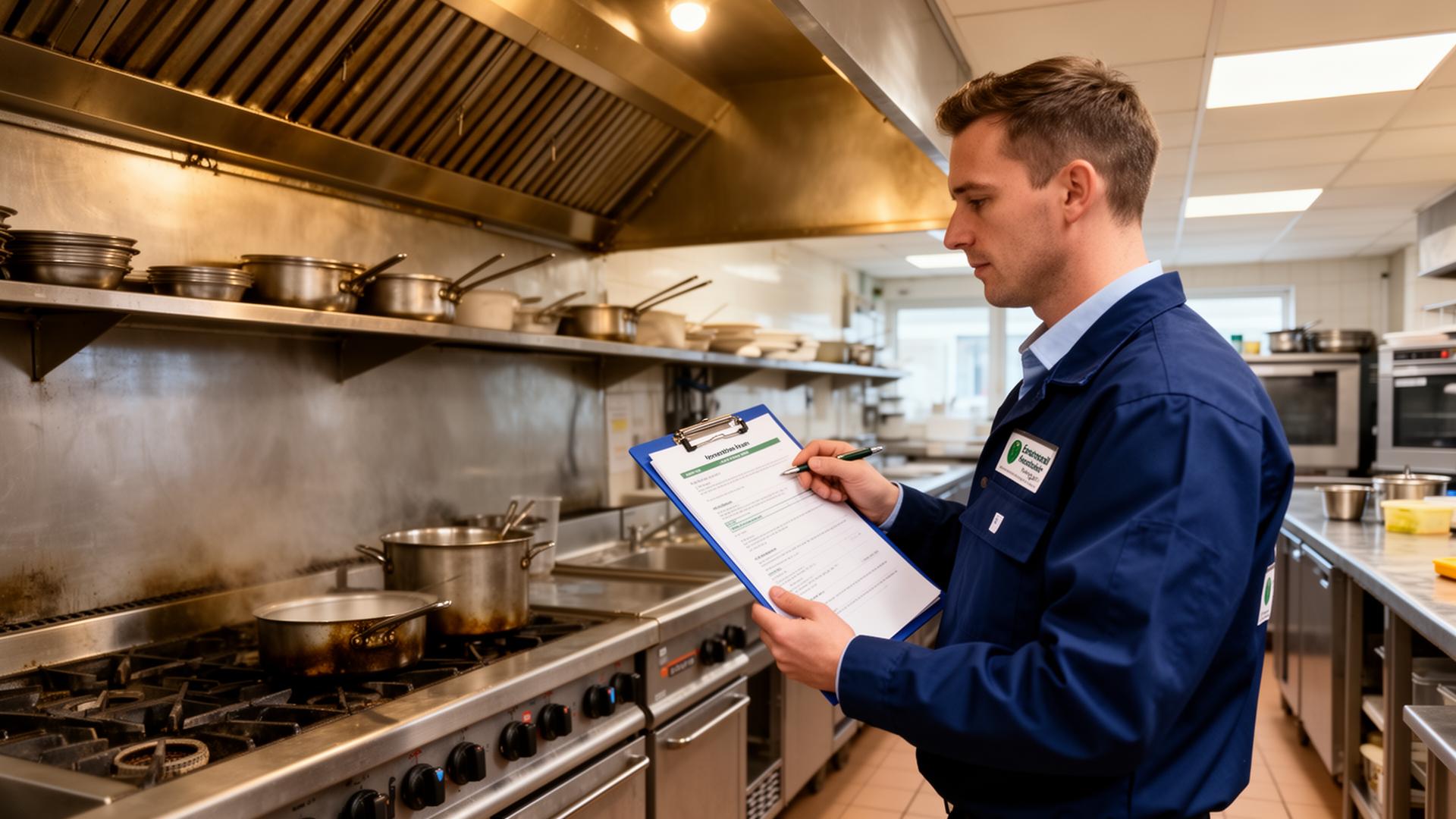
Every commercial kitchen in the UK is subject to environmental health inspections. Local authority environmental health officers (EHOs) visit restaurants, cafes, takeaways, hotels, pubs, care homes, schools, and hospitals to assess food hygiene standards — and the results directly affect the business's food hygiene rating.
For commercial kitchen cleaning contractors, this creates both an obligation and an opportunity. An obligation, because your clients rely on the evidence you provide to support their compliance. And an opportunity, because contractors who understand what EHOs look for — and who produce the right documentation — become indispensable to their clients.
This guide explains how environmental health inspections work, what role your cleaning documentation plays, and why kitchen hygiene certificates are becoming essential for your clients.
How Environmental Health Inspections Work
In England, Wales, and Northern Ireland, the Food Standards Agency oversees the food hygiene rating scheme, which is administered by local authorities. In Scotland, the equivalent is Food Standards Scotland.
Environmental health officers conduct unannounced inspections of food businesses. The inspection assesses three main areas:
Hygienic food handling. How food is prepared, cooked, reheated, cooled, and stored. This includes temperature controls, cross-contamination prevention, and allergen management.
Physical condition of the premises. The cleanliness, layout, lighting, ventilation, and condition of the building, equipment, and facilities. This is where your cleaning work directly contributes.
Food safety management. The documented systems and processes the business uses to manage food safety, including HACCP (Hazard Analysis Critical Control Point) plans, cleaning schedules, and staff training records.
Each area is scored, and the combined score determines the food hygiene rating — from 0 (Urgent improvement necessary) to 5 (Very good).
Where Your Cleaning Work Fits In
The physical condition assessment is directly influenced by the standard of professional cleaning. When an EHO inspects a kitchen, they look at:
- Extraction canopy and filter cleanliness
- Wall surfaces behind cooking equipment
- Floor condition, including corners and drainage
- Ceiling tiles and light fittings
- Cold room and storage area cleanliness
- Equipment surfaces and undersides
- Waste areas and bin stores
If these areas are visibly dirty, the score suffers. If they are clean and the business can produce documented evidence of regular professional cleaning, the score benefits.
This is where your hygiene certificate becomes directly valuable to your client.
What EHOs Want to See
Environmental health officers are not just looking at whether the kitchen is clean on the day of their visit. They want to see evidence of ongoing, systematic cleaning management. This means:
Documented cleaning schedules. A clear schedule showing what is cleaned, how often, and by whom. Your hygiene certificates contribute to this by documenting the deep clean element of the schedule.
Evidence of professional cleaning. Certificates from professional cleaning contractors carry more weight than self-declarations. An EHO recognises the difference between a restaurant manager ticking a box on their own checklist and a professional contractor producing a branded certificate with photographs and a signed declaration.
Consistency over time. A single certificate is useful. A series of certificates showing regular professional deep cleans over months or years is powerful evidence of ongoing compliance. This is why tracking cleaning intervals and maintaining a certificate history is so important.
Photographic evidence. Photographs within your certificates provide visual evidence of the standard of work. Before and after photos are particularly effective because they demonstrate the improvement achieved.
The Food Hygiene Rating Impact
For your clients, the food hygiene rating is not just a number on a sticker in the window. It has real commercial consequences.
Consumer confidence. Customers increasingly check food hygiene ratings before choosing where to eat. A rating of 5 inspires confidence. A rating of 3 or below raises concerns.
Online visibility. Food hygiene ratings are publicly available on the FSA website and appear on platforms like Just Eat, Deliveroo, and TripAdvisor. A poor rating is visible to every potential customer.
Contract requirements. Many corporate clients, event venues, and contract catering opportunities require a minimum food hygiene rating (typically 4 or 5) as a condition of doing business.
Insurance implications. Some insurance policies reference food hygiene ratings, and a deterioration in rating following an inspection could affect cover or premiums.
When you provide professional hygiene certificates, you are directly helping your client protect and improve their food hygiene rating. This makes your service far more valuable than just "cleaning the kitchen".
How to Position Your Certificates for Maximum Impact
To maximise the value of your hygiene certificates for your clients and their EHO inspections:
Use a consistent format. Every certificate should look the same — same branding, same layout, same level of detail. This demonstrates a systematic professional service, not ad hoc cleaning.
Include comprehensive area checklists. Do not just write "kitchen deep clean". List every area covered: canopy exterior, walls behind cooking equipment, floors, drainage, cold rooms, storage areas, ceiling tiles. This specificity is exactly what EHOs want to see.
Always include photographs. A certificate with photographs is significantly more credible than one without. Before and after photos of key areas demonstrate the standard of work achieved.
Recommend the next clean date. Including a recommended next clean date shows that you and your client are managing cleaning proactively, not reactively. This is strong evidence of a systematic approach.
Make certificates easily accessible. Your client should be able to produce their cleaning certificates immediately when an EHO asks for them. A client portal where certificates are stored and downloadable is ideal.
Building Long-Term Client Relationships
When your clients understand the direct link between your hygiene certificates and their food hygiene rating, the relationship changes fundamentally.
You are no longer a cost to be minimised. You are a compliance partner whose documentation directly protects their business. This shift has three practical effects:
Reduced price sensitivity. Clients who understand the compliance value of your certificates are less likely to shop around on price alone.
Higher retention. Clients who have built up a library of your certificates are reluctant to switch providers and lose that documentation continuity.
Increased referrals. Clients who receive positive EHO feedback about their cleaning documentation are likely to recommend you to other business owners in their network.
Generating Hygiene Certificates with TR19Flow
TR19Flow's kitchen hygiene certificate workflow is designed to produce exactly the documentation that environmental health officers want to see.
Complete the survey on your phone on site — areas cleaned, methods, products, photographs, and signature. The certificate generates automatically with a unique reference number, your company branding, and all the detail that supports your client's compliance.
Certificates are emailed to clients instantly and stored in their self-serve portal. When the EHO visits, your client can produce every certificate with a few taps.
All certificate types — TR19, Kitchen Hygiene, and BS EN 15780 — are available on every TR19Flow plan from £49 per month.