
If you operate a commercial kitchen deep cleaning business, you know that delivering a great clean is only half the job. The other half is proving it.
Environmental health officers, food safety auditors, insurance assessors, and facilities managers all want the same thing: documented, repeatable evidence that professional cleaning has been carried out to a consistent standard.
Contractors who build a robust compliance process — one that produces professional certificates, maintains a clear audit trail, and tracks cleaning schedules automatically — win more contracts, retain more clients, and command higher prices than those who rely on verbal confirmations and text messages.
This guide walks through how to build that compliance process from scratch.
Why Process Matters More Than You Think
Let us start with a reality that many cleaning contractors overlook: your clients do not just pay for the clean. They pay for the confidence that comes with proper documentation.
Consider two scenarios:
Scenario A: You clean the kitchen, take a few photos on your phone, send a WhatsApp message saying "all done", and invoice the client. Three months later, an environmental health officer asks the restaurant manager for evidence of professional cleaning. The manager scrolls through their WhatsApp history looking for your message. Maybe they find it. Maybe they do not.
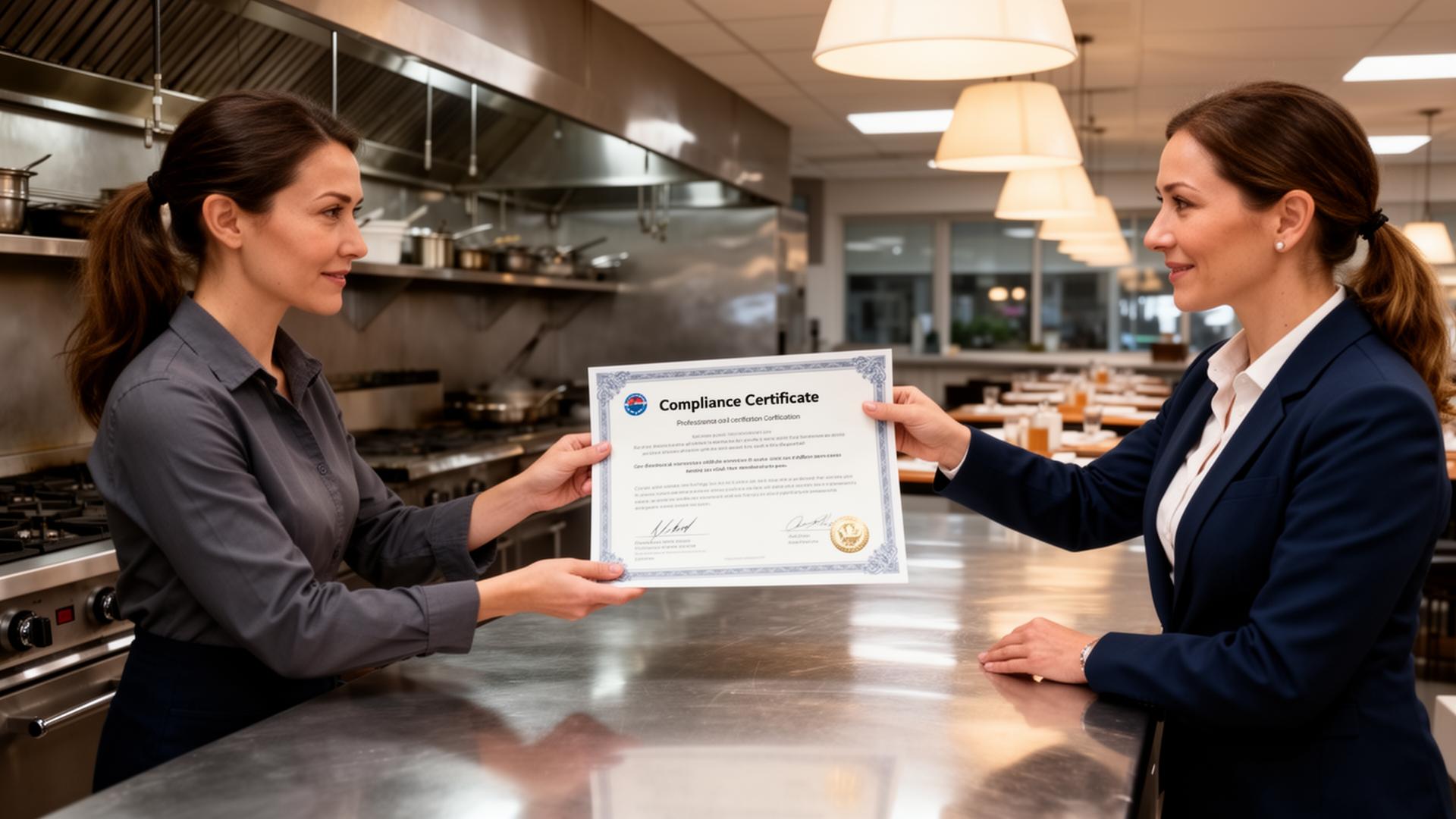
Scenario B: You clean the kitchen, complete a structured survey on your phone, upload photographs, capture a signature, and a branded compliance certificate is automatically generated and emailed to the client within minutes. Three months later, the same environmental health officer asks for evidence. The manager opens their portal, downloads the certificate, and presents it immediately.
Scenario B wins every time. And the difference is not the quality of the clean — it is the quality of the process.
The Five Pillars of a Professional Compliance Process
1. Standardised Scope of Work
Every job should start with a clear, documented scope of work. Which areas are being cleaned? What methods will be used? What products will be applied? What is explicitly excluded?
This does not need to be a lengthy document. A simple checklist that covers the standard areas — canopy exterior, walls behind cooking equipment, floors, drainage, cold rooms, storage areas, ceiling tiles, and any site-specific additions — is sufficient.
The key is consistency. Every job follows the same checklist. Every operative knows what is expected. Every client receives the same level of documentation.
2. On-Site Evidence Capture
Documentation should happen on site, in real time, as part of the cleaning workflow. Not later that evening. Not the next morning when you are trying to remember which photos were from which site.
Effective on-site evidence capture includes:
- Timestamped photographs showing conditions before and after cleaning
- A structured survey form recording areas cleaned, methods used, and products applied
- Operative name and digital signature
- Start and finish times
When this data is captured on a phone while the operative is still on site, it eliminates the admin burden of writing up reports later and ensures accuracy.
3. Automated Certificate Generation
The moment the survey is completed and the signature captured, a professional branded certificate should generate automatically. No Word templates. No manual formatting. No waiting until you get back to the office.
The certificate should include all the information captured on site — job details, areas cleaned, methods and products, photographs, signature, and a unique reference number. It should be branded with your company logo and formatted consistently for every job.
Automatic generation eliminates the number one reason contractors stop producing certificates: the time it takes to create them manually.
4. Client Access and Delivery
The certificate should be delivered to the client immediately — ideally via automated email the moment it is generated. But delivery alone is not enough.
Clients need to be able to access their certificates at any time, without calling you. A client portal where they can log in, view their sites, download certificates, and see upcoming scheduled cleans provides enormous value and differentiates your service from competitors.
When an environmental health officer or auditor requests documentation, your client can produce it in seconds rather than calling you and waiting for you to dig through your files.
5. Renewal Tracking and Scheduling
Every certificate should include a recommended next clean date. And that date should feed into an automated tracking system that alerts you when each site is coming due.
This is where the real business value lies. A renewal dashboard that flags upcoming, due, and overdue sites means you are always proactively scheduling the next clean rather than waiting for clients to remember to call you.
Contractors who implement renewal tracking typically see a significant reduction in client churn and missed bookings. The system sells the next job for you.
Putting It All Together
A complete kitchen deep clean compliance process looks like this:
- Job created with defined scope and scheduled date
- On-site survey completed on phone — areas, methods, products, photos, signature
- Certificate generated automatically as branded PDF
- Certificate delivered to client via email and stored in portal
- Next clean date tracked in renewal dashboard
- Reminder sent when the next clean is approaching
This entire workflow can run from your phone. No office admin. No paper forms. No Word templates. No lost certificates.
The Competitive Advantage
Contractors who implement this process consistently report three outcomes:
They win more contracts. When pitching to new clients — especially multi-site operators and facilities management companies — the ability to demonstrate a professional compliance process with branded certificates and client portal access is a significant differentiator.
They retain more clients. The combination of professional documentation and proactive renewal tracking makes it difficult for clients to justify switching to a competitor. Your certificates become part of their compliance file.
They charge higher prices. A documented compliance service is worth more than an undocumented clean. Clients who receive professional certificates perceive higher value and are less sensitive to price.
Getting Started with TR19Flow
TR19Flow provides the complete compliance workflow described in this guide. Kitchen hygiene surveys, automated certificate generation, client portal, email delivery, and renewal dashboard — all from your phone, all on every plan.
If you are currently producing certificates manually (or not at all), the difference is immediate. Your first certificate generates in minutes, not hours.