
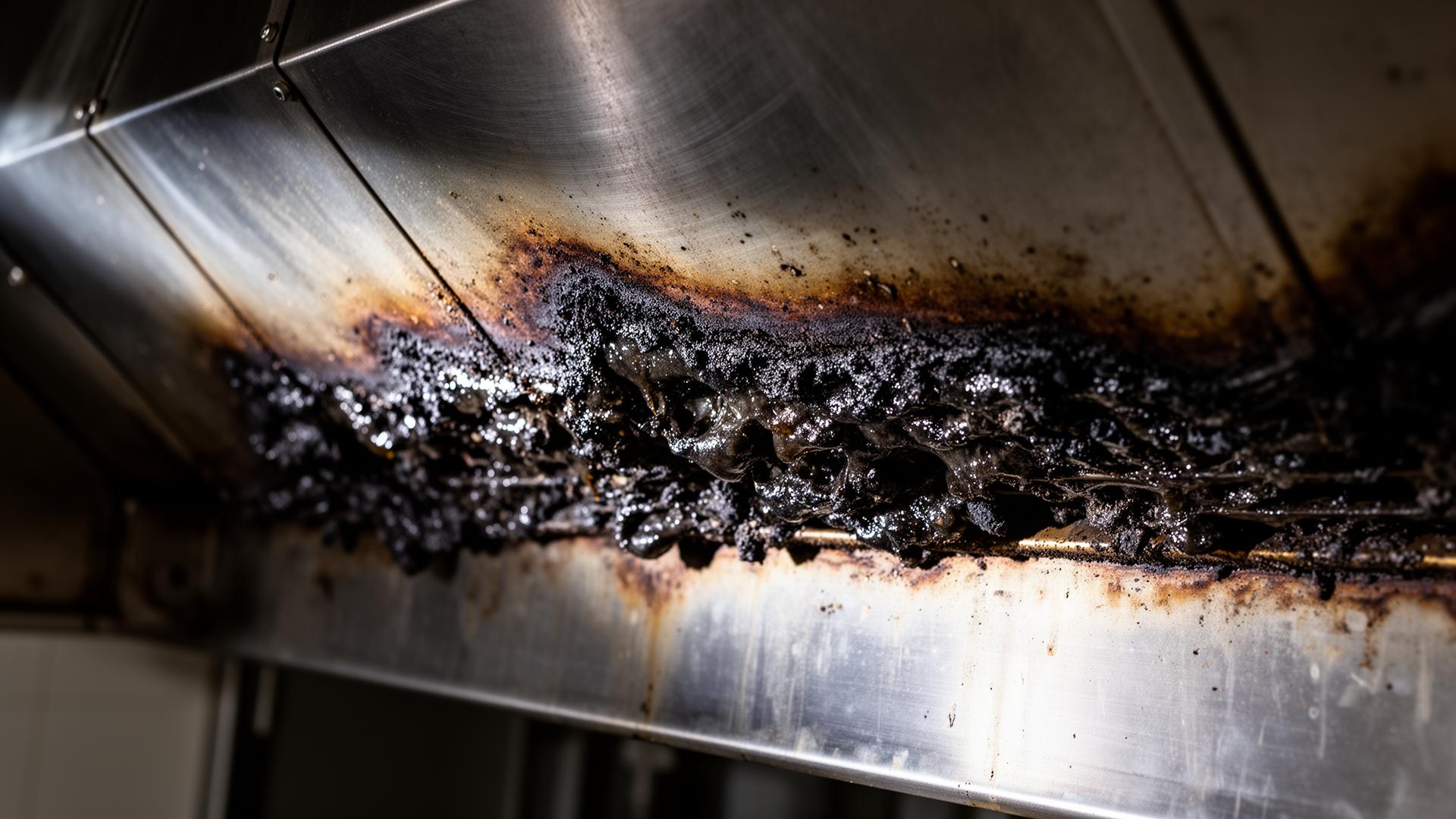
If you clean kitchen extract systems for a living, you deal with grease every day. You scrape it, dissolve it, blast it with hot water, and measure what is left behind. But how much do you really understand about what grease actually is, how it forms inside a duct, and why some deposits are soft and easily removed while others seem welded to the metal? Understanding the science behind grease accumulation does not just make you a more knowledgeable contractor — it makes you a better one. It helps you choose the right cleaning methods, set realistic expectations with clients, and explain why regular cleaning is not a luxury but a necessity.
What Is Kitchen Grease?
When we talk about "grease" in the context of kitchen extract systems, we are actually talking about a complex mixture of substances. Cooking produces grease-laden vapour — a combination of vaporised fats, oils, and water that is generated when food is heated. The composition of this vapour depends on what is being cooked and how. Deep frying produces large volumes of oil vapour. Grilling generates rendered animal fat. Even steaming and boiling release smaller quantities of water-soluble fatty acids.
This vapour is drawn into the extract system by the fan, passing first through the canopy and filters, then through the ductwork, and finally being expelled through the discharge point. At every stage of this journey, some of the grease-laden vapour condenses onto cooler surfaces, in the same way that steam from a shower condenses on a bathroom mirror. The canopy and filters capture a significant proportion of the grease — a well-maintained set of baffle filters can capture 90% or more of the grease particles — but the remaining 10% enters the ductwork. Over time, this residual grease accumulates on the internal surfaces of the duct, building up layer by layer with each cooking shift.
The Chemistry of Polymerisation
Here is where things get interesting, and where many contractors do not fully appreciate what is happening inside the duct. Fresh grease deposits are relatively soft and oily. If you could clean the duct the same day the grease was deposited, it would wipe off easily. But grease does not stay in its original state for long. It undergoes a chemical process called polymerisation, in which the fat molecules react with oxygen in the air and link together to form longer, more complex molecular chains. This is the same process that causes cooking oil left in a pan to become sticky and hard over time.
Polymerisation is accelerated by heat and by exposure to air — both of which are abundant inside a kitchen extract duct. The extract system draws hot air continuously during cooking, and the ductwork is ventilated even when the kitchen is not operating, so the deposited grease is constantly exposed to conditions that promote polymerisation. Within days, fresh grease begins to harden. Within weeks, it becomes a tough, adhesive coating that is significantly more difficult to remove than the original soft deposit.
This is why cleaning frequency matters so much. A system that is cleaned every three months is dealing with grease that has had three months to polymerise. A system that is cleaned annually is dealing with grease that has had twelve months to polymerise. The difference in cleaning difficulty is not linear — it is exponential. Twelve-month-old grease is not merely four times harder to remove than three-month-old grease. It can be ten or twenty times harder, requiring more aggressive cleaning chemicals, higher water pressures, longer contact times, and more physical effort from your team. This is reflected in the cost, but many clients do not understand why, and it is your job to explain it.
Carbonisation: When Grease Becomes Armour
If polymerisation makes grease difficult to remove, carbonisation makes it almost impossible. Carbonisation occurs when grease deposits are exposed to sustained high temperatures — typically in the sections of ductwork closest to the canopy, and particularly in systems serving high-heat cooking equipment such as woks, chargrills, and tandoori ovens. At these temperatures, the polymerised grease undergoes further chemical changes, losing its remaining volatile components and converting into a hard, britite, carbon-rich residite that is essentially baked onto the metal surface.
Carbonised grease has a dark brown or black appearance and a rock-hard texture. It cannot be removed by conventional chemical cleaning or pressure washing alone. It typically requires mechanical removal — scraping with hand tools or using specialised rotary cleaning equipment. In extreme cases, sections of ductwork may need to be replaced entirely because the carbonised deposits have compromised the structural integrity of the metal or are so thick that they significantly reduce the effective diameter of the duct.
For contractors, recognising the difference between polymerised grease and carbonised grease is essential because it determines your cleaning methodology and your pricing. If you quote for a standard chemical clean and discover carbonised deposits on the day, you will either need to absorb the cost of the additional work or have a difficult conversation with the client. A thorough pre-clean survey that includes internal inspection of the ductwork will identify carbonised deposits before you commit to a price.
Grease Distribution Patterns
Grease does not accumulate evenly throughout an extract system. Understanding where it concentrates helps you focus your cleaning efforts and provides better outcomes for your clients. The heaviest deposits typically occur in three areas.
First, the horizontal sections of ductwork immediately above the canopy. This is where the temperature differential between the hot vapour and the cooler duct surface is greatest, causing maximum condensation. Horizontal sections also lack the benefit of gravity — in vertical risers, condensed grease tends to run down the duct walls and may drip back towards the canopy, but in horizontal sections, it pools and accumulates.
Second, at bends and junctions. When the airflow changes direction, grease particles are thrown against the outer wall of the bend by centrifugal force, in the same way that water sloshes to one side when you turn a corner while carrying a bucket. These accumulation points can develop surprisingly thick deposits even when the straight sections of ductwork remain relatively clean.
Third, at the fan. The fan impeller disrupts the airflow and creates turbulence, which causes grease particles to deposit on the fan blades, the volute casing, and the area immediately upstream and downstream of the fan. A heavily contaminated fan is not just a fire risk — it is an efficiency risk. Grease on the impeller unbalances the fan, increasing vibration, reducing airflow, and accelerating bearing wear. Left unchecked, a grease-laden fan will fail prematurely, leaving the kitchen without extraction and potentially triggering a shutdown by environmental health.
The Role of Air Velocity
Air velocity within the ductwork has a significant effect on grease deposition. TR19 references design air velocities for kitchen extract systems, and there is a reason for this. If the air velocity is too low, grease particles settle out of the airstream more readily, increasing deposition rates. If the air velocity is too high, the increased turbulence can actually increase deposition at bends and obstructions. The optimum velocity keeps grease particles entrained in the airstream long enough for them to reach the discharge point rather than depositing on the duct walls.
In practice, many kitchen extract systems do not maintain optimal air velocities throughout. Ductwork that was designed for a lighter-use kitchen may be undersized for a subsequent tenant running a high-volume frying operation. Extensions and modifications to the system can create areas of reduced velocity where grease accumulates faster. And as grease builds up on the duct walls, it reduces the effective cross-sectional area, increasing velocity in some sections and creating dead spots in others. This creates a feedback loop: grease accumulation changes the airflow characteristics, which in turn changes the deposition pattern, potentially creating dangerous concentrations of grease in unexpected locations.
This is another reason why regular TR19 cleaning is essential. Each clean resets the system to a baseline condition, restoring designed airflow characteristics and preventing the feedback loop from developing.
Implications for Your Cleaning Practice
Understanding grease chemistry has direct practical implications for how you approach each job. For light, fresh deposits, alkaline degreasing chemicals with appropriate contact time will be effective. These chemicals work by saponifying the fats — converting them into a water-soluble soap that can be rinsed away. For polymerised deposits, you need stronger chemicals with longer contact times, and you may need to apply heat to soften the deposits before chemical treatment. For carbonised deposits, mechanical removal is usually necessary, followed by chemical cleaning to remove residual contamination.
Your post-clean DFT readings will tell you whether your cleaning method was effective. If you are consistently seeing readings above the acceptable threshold after cleaning, it may indicate that the deposits are more polymerised or carbonised than you initially assessed, and you need to adjust your approach. This is where experience and scientific understanding intersect: knowing what you are dealing with at a molecular level helps you select the right tools and techniques to achieve compliant results.
When you explain this to your clients — when you show them why their system needs cleaning every six months instead of every twelve, and what happens to the grease between cleans — you are not just justifying your price. You are demonstrating expertise that sets you apart from every competitor who treats grease as a generic substance to be blasted away without understanding.