
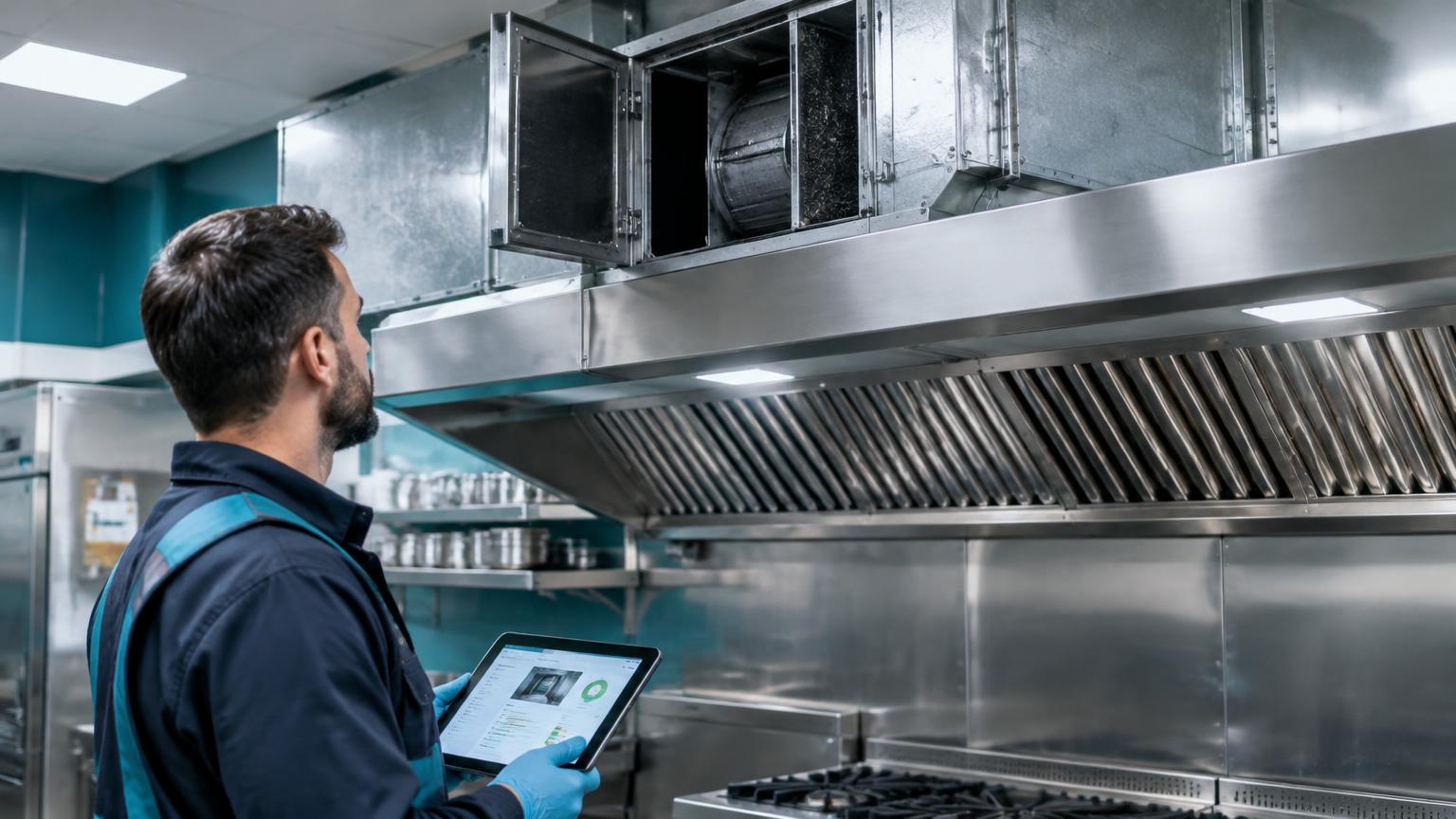
TR19 in one paragraph
TR19 is a technical specification published by BESA, the Building Engineering Services Association (formerly the HVCA, which first published it). The name is short for Technical Report 19. It describes how to assess the internal cleanliness of ventilation ductwork, when cleaning is needed, how the work should be carried out and how the result should be verified and recorded. It is not an Act of Parliament, but it is the document most UK insurers, landlords and fire risk assessors point to when they want proof that a kitchen extract system has been properly maintained.
When a restaurant manager asks for “TR19 cleaning”, they usually mean: clean the whole extract system to the BESA specification, from the canopy to the discharge, and give me a report I can show my insurer. The rest of this guide unpacks what that involves.
TR19 Grease and TR19 Air: two documents, two jobs
BESA now publishes the specification in two parts. TR19 Grease deals with kitchen extract systems, where the main risk is fire from accumulated cooking deposits. TR19 Air deals with general supply and extract ventilation, where the concern is cleanliness and indoor air quality. Most of what clients call “TR19” is TR19 Grease.
| TR19 Grease | TR19 Air | |
|---|---|---|
| Systems covered | Kitchen canopies, plenums, grease ductwork, fans and discharges | Supply and extract ventilation, AHUs and general ductwork |
| Main risk | Fire spread through grease-laden ductwork | Dust and contaminants affecting air quality and hygiene |
| Typical evidence | Deposit-thickness readings, before and after photos, access limitations, next-clean date | Cleanliness class assessment, test locations, photos, reinspection date |
| Usual client | Restaurants, hotels, schools, hospitals, contract caterers | Offices, healthcare, retail, education and public buildings |
| Related standard | Insurer and fire-risk expectations | Often read alongside BS EN 15780 |
What TR19 cleaning and TR19 duct cleaning involve on site
A TR19 clean is a whole-system job, not a canopy wipe-down. Filters and the visible canopy are only the start; the fire risk usually sits further in, in the plenum, the horizontal duct runs, bends, the riser and the fan housing. A competent team works through the system in a logical order and records what it found and what it could not reach.
- Survey the system: identify the canopy, plenum, duct runs, riser, fan and discharge, and confirm access panels
- Record the pre-clean condition with labelled photographs and deposit-thickness readings
- Isolate and protect: fans off, appliances safe, surrounding areas sheeted
- Clean each section using methods suited to the deposit (manual scraping, chemical, steam or mechanical)
- Verify the result with matching after photographs and post-clean readings
- Record inaccessible sections honestly, with the reason and the access work needed
- Set and record a recommended next-clean date based on usage and what was found
- Hand over the post-clean verification report (PCVR) and certificate
Is TR19 a legal requirement?
Not directly. No UK law names TR19. The legal duty comes from fire safety law: in England and Wales the Regulatory Reform (Fire Safety) Order 2005 requires the “responsible person” for non-domestic premises to assess and reduce fire risk. Scotland and Northern Ireland have their own equivalent fire safety legislation. A poorly maintained grease extract is an obvious fire risk, so the responsible person has to show it is being managed.
That is where TR19 comes in. Because it is the recognised industry specification, a TR19 clean backed by a proper report is the most straightforward way for a site to show it has met that duty. Many commercial insurance policies go further and make cleaning “to TR19” or at stated intervals a condition of cover. If a fire starts in the ductwork and the site cannot produce the evidence, the insurer may refuse or reduce a claim.
For a contractor, the practical message to clients is simple: TR19 is not the law, but it is how you prove you have complied with it, and your insurer is very likely to ask for it. Always advise clients to check their own policy wording, and avoid giving legal advice beyond that.
How often does TR19 say a kitchen extract should be cleaned?
TR19 Grease links baseline cleaning intervals to how heavily the kitchen is used. These are starting points: measured accumulation and the competent person's assessment decide the recommendation for a particular system.
| Kitchen usage | Typical daily operation | Baseline cleaning interval |
|---|---|---|
| Heavy | 12–16 hours a day | About every 3 months |
| Moderate | 6–12 hours a day | About every 6 months |
| Light | 2–6 hours a day | About every 12 months |
Grease deposit limits and micron readings
TR19 Grease uses deposit-thickness measurement, usually taken with a wet film thickness gauge, to move the conversation from “it looks greasy” to recorded evidence. Readings are in microns (µm); one micron is a thousandth of a millimetre. A mean deposit of around 200 µm across the system is the figure most commonly quoted as the point at which cleaning is needed, and much higher local readings are treated as hot spots needing prompt action. Check the current BESA edition for the exact wording and verification criteria rather than relying on second-hand summaries.
Whatever the threshold, the evidence only stands up if each reading is tied to a location, the units are consistent and the calculation can be checked. A single average with no test points behind it is easy for an insurer or auditor to question.
What a TR19 certificate and report should contain
Clients ask for a “TR19 certificate”, but what protects them is the evidence behind it. The certificate is the short declaration of what was cleaned and when; the post-clean verification report (PCVR) is the detailed record that backs it up.
- Client, site address and a clear system identifier or schematic
- Date of the clean, job reference and the operatives involved
- The scope cleaned, from canopy to discharge, and any exclusions
- Before and after photographs with location labels
- Pre- and post-clean deposit readings with their locations and the calculated mean
- Inaccessible areas, defects and recommended remedial work such as extra access panels
- Cleaning methods and chemicals used
- The recommended next-clean date and the reason for it
- Contractor details and sign-off
Where BESA's Vent Hygiene Register fits
BESA and BESCA run the Vent Hygiene Register (VHR) for eligible ventilation hygiene businesses. Registered members notify qualifying work through the VHR Hub, which produces the official completion certificate. That is separate from the contractor's own PCVR and certificate. Clients and insurers increasingly ask whether a contractor is on the VHR, but membership never replaces the job evidence, and contractor software does not issue the official VHR certificate.
Who can carry out TR19 cleaning?
TR19 expects the work to be done by competent, trained people. In practice clients and insurers look for operatives with recognised grease hygiene training, contractors with appropriate insurance and, increasingly, VHR registration. Competence also shows in the paperwork: a report that records access limitations honestly and explains its next-clean recommendation reads very differently from a one-line certificate.
Worked example: a TR19 clean for a busy restaurant
A 120-cover restaurant runs its extract from 9am to 11pm, so roughly 14 hours a day, which puts it in the heavy usage band. The survey identifies one canopy, a plenum, an eight-metre horizontal run with two bends, a riser to the roof and a roof-mounted fan. Five test points are recorded before cleaning, with a mean well above the cleaning trigger and a higher reading near the second bend.
The team cleans every accessible section, takes matching after photographs and post-clean readings, and records that two metres of riser could not be reached because there is no access panel. The report recommends a three-month interval and quotes for fitting an access panel before the next visit. The client gets a clear certificate, a report their insurer can follow and a priced remedial action; the contractor gets a booked renewal and an additional job.
The admin side of TR19 work
For most TR19 cleaners the cleaning is the easy part. The time goes on the evening afterwards: sorting photographs from several phones, typing micron readings into a spreadsheet, rebuilding the report in Word, chasing the invoice and remembering to rebook the next clean in three or six months.
That is the problem TR19Flow is built for. Operatives capture the survey, labelled photographs, readings, limitations and signatures on a phone or tablet. The mean is calculated for them, the branded report and certificate are produced from the same record, the client can download it from their portal and the next-clean date goes straight onto a renewal dashboard with reminders. You can try it on a real job with a 14-day free trial.
Quick TR19 checklist for contractors
- Whole system surveyed and identified, canopy to discharge
- Pre-clean photos and readings labelled by location
- Every accessible section cleaned; inaccessible sections recorded with a reason
- Post-clean photos from matching viewpoints and post-clean readings
- Next-clean date set from usage and measured condition
- PCVR and certificate checked, sent and archived against the job
- Renewal booked before the next-clean date falls due
Questions contractors ask
What does TR19 stand for?
Technical Report 19, the ventilation hygiene specification published by BESA (formerly the HVCA). It is now split into TR19 Grease for kitchen extract and TR19 Air for general ventilation.
Is TR19 a legal requirement?
TR19 itself is not law. Fire safety law requires the responsible person to manage fire risk, and a TR19 clean with a proper report is the recognised way to show a kitchen extract is being managed. Many insurers also make TR19 cleaning a condition of cover.
What is the difference between TR19 cleaning and a canopy clean?
A canopy or filter clean only covers the visible parts. TR19 cleaning covers the whole extract system, including the plenum, ductwork, riser, fan and discharge, and is verified and documented.
How often is TR19 cleaning needed?
As a baseline, about every 3 months for heavy use (12–16 hours a day), 6 months for moderate use and 12 months for light use, adjusted by measured grease accumulation and the competent person's assessment.
What is a TR19 certificate?
A contractor's declaration that a specified extract system was cleaned on a given date, normally backed by a post-clean verification report with photographs, readings, limitations and a next-clean date.
Is a TR19 certificate the same as a VHR certificate?
No. The official VHR completion certificate comes from a registered member notifying the work through the VHR Hub. The contractor's TR19 certificate and PCVR are the job evidence.
What does BESA TR19 Grease say about micron readings?
It uses deposit-thickness measurement to decide when cleaning is needed and to verify the result. A mean of around 200 µm is commonly cited as the cleaning trigger; check the current edition for the exact criteria.
Can software produce TR19 reports?
Yes. Software such as TR19Flow captures the photos, readings and sign-off on site and produces the contractor report and certificate. It does not replace competent cleaning or the VHR Hub.