
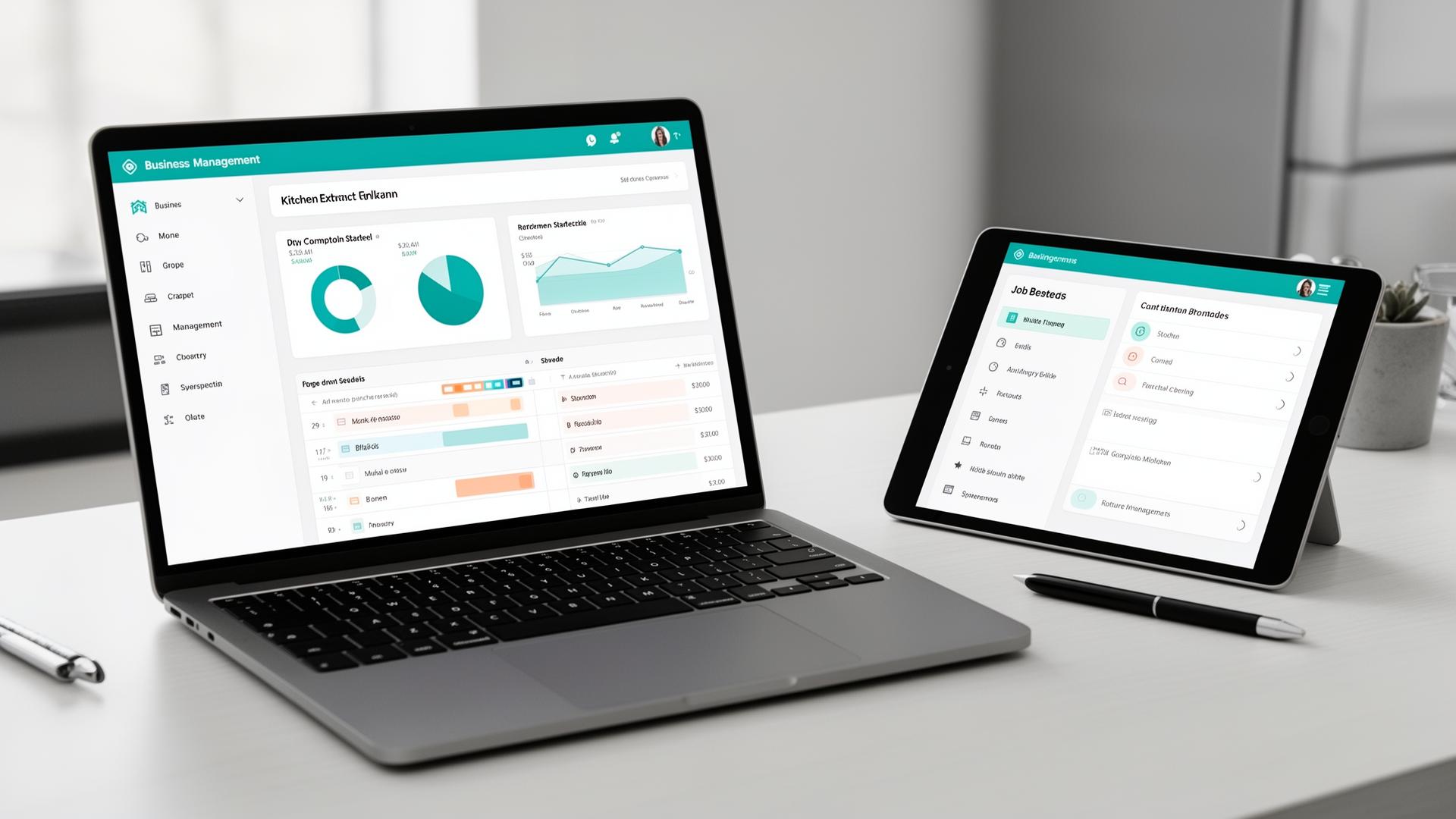
Running a kitchen extract cleaning business involves far more than cleaning ductwork. There is scheduling, quoting, certification, invoicing, renewal tracking, client communication, and compliance documentation to manage — often for dozens or hundreds of sites simultaneously.
Most contractors start with paper-based systems or spreadsheets. Some graduate to generic field service management software. But the unique requirements of TR19 work — micron readings, specific report formats, compliance certification, renewal frequency management — mean that general-purpose tools always fall short in critical areas.
This guide examines the software landscape for kitchen extract cleaning businesses and what to look for in a system that genuinely fits the work.
The Software Challenge for Specialist Contractors
Kitchen extract cleaning is a specialist trade. The work is governed by the BESA TR19 Grease Specification, which sets specific requirements for documentation, measurement, and reporting that do not apply to other types of cleaning or maintenance work.
This creates a mismatch with generic software. A standard field service management platform can handle job scheduling and invoicing, but it cannot:
- Generate TR19-compliant post-clean verification certificates
- Record and validate micron readings against BESA thresholds
- Track renewal dates based on kitchen use categories
- Produce system schematics for TR19 reports
- Manage the specific data fields required by the specification
The result is that contractors using generic software end up maintaining parallel systems — the software for scheduling and invoicing, and a separate process (often manual) for TR19 documentation and compliance.
What Generic Field Service Software Gets Wrong
Generic field service platforms are designed to be flexible enough to serve any trade — plumbers, electricians, HVAC engineers, cleaners. This flexibility is both their strength and their weakness.
Job forms are generic — You can create custom fields, but building a full TR19 report template with pre and post-clean readings, measurement locations, compliance calculations, and photographic evidence slots is cumbersome and fragile.
No built-in compliance logic — Generic software does not know that a post-clean mean above 50µm is a failure, or that a reading above 500µm is a hot spot. Any compliance checking must be done manually.
Certificate generation is absent — The TR19 post-clean verification certificate is a specific document format. Generic software typically offers generic report templates that do not meet the specification requirements.
Renewal tracking is basic — Most field service platforms have some form of recurring job scheduling. But TR19 renewals are more nuanced — different sites have different frequencies based on kitchen use category, and the renewal date should be calculated from the last clean date, not from a fixed schedule.
Client portal features lack context — Some platforms offer client portals, but they show generic job histories rather than the specific compliance information that kitchen extract clients need — certificates, renewal status, system histories.
Categories of Tools Contractors Need
A kitchen extract cleaning business needs software that covers several functional areas:
Job Scheduling
The ability to schedule cleaning jobs, assign crews, and manage the calendar. Key requirements include:
- Multi-crew scheduling
- Site-specific information accessible to the crew on arrival
- Access instructions, parking notes, and contact details
- Job status tracking from scheduled through to complete
TR19 Certificate Generation
The most critical differentiator. The software must generate TR19 post-clean verification certificates that include every mandatory field required by the BESA specification:
- Contractor and operative details
- Site information
- Pre and post-clean micron readings with pass/fail calculation
- Photographic evidence
- System schematic
- Compliance declaration
Renewal Tracking
Kitchen extract systems must be cleaned at regular intervals determined by kitchen use category. The software must:
- Store the cleaning frequency for each site
- Calculate the next due date from the last clean
- Send reminders before the due date
- Provide a dashboard showing all sites by compliance status (red, amber, green)
- Alert the contractor when sites become overdue
Invoicing
The ability to generate and send invoices for completed work. Integration with accounting software is a bonus but not essential for most contractors.
Client Communication
Keeping clients informed about upcoming cleans, completed work, and renewal dates. This includes:
- Email notifications when work is completed
- Certificate delivery
- Renewal reminders sent to the client
- A client portal where clients can access their own compliance documentation
What to Look For in TR19-Specific Software
When evaluating software specifically for kitchen extract cleaning work, the following criteria matter most:
TR19 certificate compliance — The certificates generated must meet the full requirements of the BESA TR19 Grease Specification. Check that they include all mandatory fields, not just the obvious ones.
Mobile-first data capture — Operatives need to capture micron readings, photographs, and observations on site, typically from a mobile device. The software should work on phones and tablets, ideally with offline capability for sites with poor signal.
Renewal dashboard — A clear, at-a-glance view of all sites showing their compliance status. The RAG (red, amber, green) approach is the industry standard and the most intuitive way to manage renewals.
Client portal — A self-service portal where clients can access their own certificates, view renewal dates, and download reports. This reduces admin time and improves client satisfaction.
Scalability — The software should handle growth from 20 sites to 200 to 2,000 without becoming unmanageable.
Integration — The ability to connect with accounting software, email platforms, and other business tools.
Why Purpose-Built Beats Generic for Compliance Work
The fundamental difference between purpose-built and generic software is context. Purpose-built software understands the domain:
- It knows what a micron reading is and how to validate it
- It knows the difference between heavy, moderate, and light use frequencies
- It knows what fields are mandatory on a TR19 certificate
- It knows that a post-clean mean above 50µm is a failure
- It knows that renewals are calculated from the last clean date, not from a fixed calendar
This domain knowledge eliminates the gap between what the software does and what the contractor needs. There is no workaround, no parallel manual process, no risk of producing non-compliant documentation.
Generic software requires the contractor to bring all of this knowledge and build it into the system through custom fields, templates, and manual processes. This works, but it is fragile, time-consuming to set up, and prone to human error.
TR19Flow — Purpose-Built for Kitchen Extract Contractors
TR19Flow is designed from the ground up for kitchen extract cleaning businesses. It combines job scheduling, mobile survey and data capture, automatic TR19 certificate generation, renewal tracking with RAG dashboard, invoicing, and a client portal — all in a single system that understands TR19 compliance.
Every feature is built with the TR19 specification in mind. Certificates are automatically generated when a job is completed, with all mandatory fields populated from data captured on site. Renewal dates are calculated automatically based on kitchen use category. The client portal gives building owners and facilities managers direct access to their compliance documentation.
The result is less admin, fewer errors, better compliance, and more time to focus on growing your business.